


Metal Garden Trellis for Climbing Plants: A Practical Buyer's Guide
A metal garden trellis for climbing plants should be selected according to the way the plant climbs, the height it is expected to reach and the place where the trellis will be installed. Frame shape matters, but so do opening size, usable growing area, anchoring, outdoor finish and access for seasonal maintenance.
For importers, garden retailers, distributors and private-label buyers, those decisions also affect assembly, carton size, shelf presentation and landed cost. This guide turns the main design choices into a clear sourcing process.

Twining, clinging, scrambling or tied-in growth
Required height, width and usable framework
Soil, planter, wall-adjacent or freestanding use
Assembled, folding or knock-down packaging
1. Match the Trellis to the Way the Plant Climbs
"Climbing plant" is a broad description. Plants attach to supports in different ways, and that changes the most useful spacing, member size and frame layout. The buyer does not need to design the plant, but the intended plant group should be stated in the RFQ.
| Growth Habit | How the Plant Uses a Support | Trellis Feature to Review |
|---|---|---|
| Twining stems | Stems wind around rods, wires or narrow framework | Continuous vertical and diagonal routes with reachable spacing |
| Tendrils | Fine tendrils grip nearby members | Enough narrow attachment points across the growing area |
| Scrambling stems | Long stems rest on or are tied to the support | Open access for tying, pruning and redistributing growth |
| Clinging plants | Roots or adhesive structures attach to a nearby surface | Whether the trellis is a guide, a spacer or the primary support |
2. Choose the Right Trellis Form
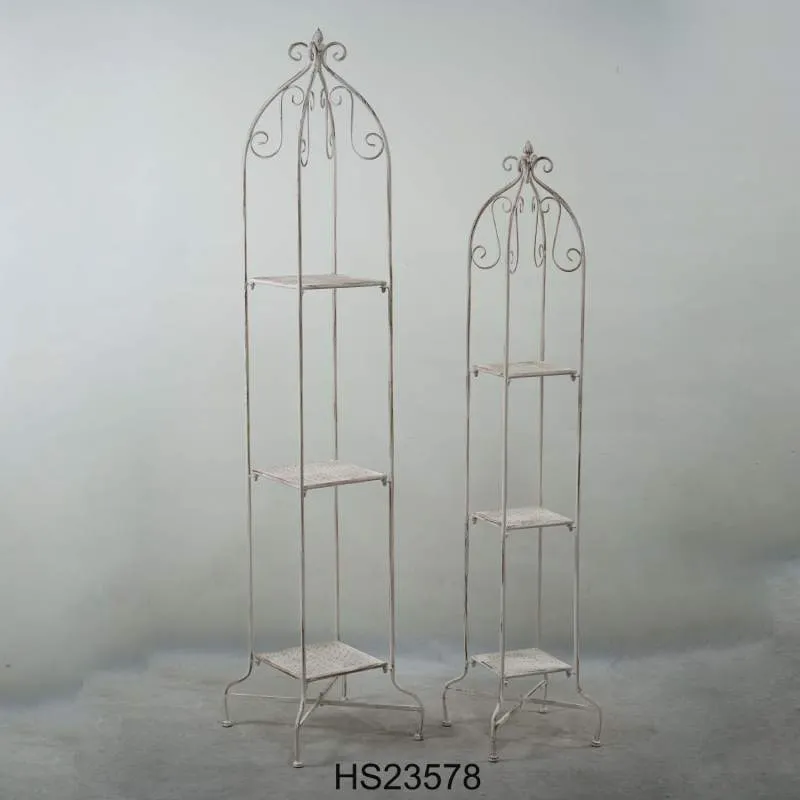
Flat panels, obelisks and arched supports can all guide climbing plants, but they occupy space differently. The product form should follow the installation site and the visual role expected by the end customer.

| Trellis Form | Best-Fit Position | Main Buyer Check |
|---|---|---|
| Flat panel | Along a wall, fence, bed edge or planter | Width, fixing points and clearance from the nearby surface |
| Obelisk or tower | Inside a bed, border or large container | Base stability, taper and access around the complete plant |
| Fan-shaped | Behind a plant that spreads as it grows | Usable width at the upper section and ground-fixing layout |
| Arched panel | Beds, borders and decorative wall-adjacent planting | Whether it supports plants or is intended mainly as decoration |
3. Size the Trellis by Usable Growing Area
Overall height is not the same as usable plant-support height. A section may enter the soil, sit inside a planter or form a decorative top that provides little attachment area. Ask the supplier to mark these zones on the drawing.

- Total product height
- Height above the soil or planter rim
- Stake or insertion length
- Maximum outer width
- Usable framework width and height
- Base footprint for freestanding designs
- Opening size at the narrowest and widest points
- Clearance from a wall, fence or container edge
- Dimensions after full assembly
Bee Wing's listed Tall Metal Garden Trellis, for example, is offered in multiple heights. Buyers should still confirm the approved drawing and packed configuration for the exact order.
For a plant expected to outgrow the frame, decide whether growth may continue above the trellis or whether the plant will be trained back across it. This decision affects the top shape and maintenance plan.
4. Check the Grid, Rings and Attachment Routes
A trellis must offer places where stems can be guided or tied. Very large openings may leave young growth unsupported, while a dense decorative grid can make pruning and untangling difficult.
Help stems move upward without long unsupported gaps.
Create attachment points and help retain the intended shape.
Allows tying, pruning, inspection and removal of old growth.
Ask for a front view with key spacing dimensions. Decorative scrolls can add useful attachment points, but the drawing should show how those parts connect to the main frame. Do not assume that every ornament is intended to carry plant load.
5. Plan the Installation Before Approving the Frame
Installation conditions change the stability requirement. A trellis pushed into deep garden soil is not evaluated in the same way as one placed in a shallow planter or positioned on a paved patio.
| Installation | Information to Confirm | Common Risk |
|---|---|---|
| Inserted into soil | Stake length, spacing, end shape and installed height | Insufficient holding in loose, wet or shallow soil |
| Inside a planter | Internal planter width, soil depth, drainage and root space | Stake conflict with the liner, wall or drainage area |
| Wall-adjacent | Fixing points, stand-off distance and wall material | Poor airflow or inaccessible rear growth |
| Freestanding on a hard surface | Base footprint, supplied supports and intended anchoring | Movement or tipping as foliage increases wind exposure |
The finished plant can catch more wind than the empty metal frame. Sample review should therefore consider mature foliage, local exposure and the actual fixing method. Any buyer-required stability test needs a defined setup rather than an unsupported general claim.
6. Compare Trellis, Cage and Garden Arch Applications
These three product types can all interact with climbing plants, but they solve different layout problems. Clear product roles also prevent a knowledge article from sending buyers to the wrong category.
| Product | Typical Layout | Primary Use | Best Next Page |
|---|---|---|---|
| Metal trellis | Flat, fan, tower or obelisk form | Creates a defined growing framework | Metal Garden Trellis |
| Metal plant cage | Surrounds one plant or a compact plant group | Guides and contains growth around the plant | Metal Garden Cage |
| Metal garden arch | Spans a path, entrance or designated feature | Combines passage clearance with overhead growth | Metal Garden Arch |
7. Specify the Metal Frame and Connections
A product photo does not define the frame. Quotations should identify whether the trellis uses wire, rod, tube or a combination, together with the dimensions of important members and the way each section connects.
- Main vertical member type and dimensions
- Cross-member, ring or scroll construction
- Welded, hooked, bolted or push-fit connections
- Section count on a knock-down trellis
- Orientation and fit of connectors
- Ground stake construction and end treatment
- Accessible edges, projections and decorative tips
- Drainage of hollow members where relevant
Changing the height or width can alter the way the frame flexes and how the joints align. A customized size should be treated as a new configuration and checked through an assembled sample.
8. Select an Outdoor Finish for the Actual Environment
Bee Wing's listed trellis products identify iron construction and powder coating, with color options depending on the design. For a bulk order, the approved specification should go beyond a color name and define the finish required for the destination and use environment.
- Surface preparation or pretreatment
- Coating system and color reference
- Gloss, texture and acceptable appearance range
- Coverage at welds, intersections and cut ends
- Coverage on ground-insertion sections
- Protection of joints during assembly and packing
- Buyer-required corrosion or coating tests
Avoid absolute "rust-free" or lifetime statements unless a defined test and service condition support them. Outdoor performance depends on the complete finish, handling, exposure and maintenance.

9. Review Assembly from the Customer's Viewpoint
A fixed trellis is easy for the customer to understand but may occupy more carton volume. Folding and knock-down designs can reduce packed size, yet they introduce joints, parts and instructions that must work reliably.
| Construction | Possible Benefit | Approval Focus |
|---|---|---|
| Fully assembled | Minimal customer setup | Frame protection, carton volume and shape retention |
| Folding | Compact storage for some forms | Hinge movement, locking method and finish rubbing |
| Knock-down | Potentially smaller shipping volume | Part identification, joint fit, alignment and instruction clarity |
During sample approval, ask someone unfamiliar with the product to assemble it using only the proposed instructions. Record the time, tools, confusing steps, surface damage and whether the final dimensions match the drawing.
10. Build Packaging Around Long, Finished Metal Parts
Trellis sections are often long relative to their weight. Without internal restraint, stakes or decorative tips may puncture the carton, frames may bend and coated surfaces may rub against each other.
Restrain stakes, finials and projecting parts so they cannot move into the carton wall.
Prevent coated parts from rubbing during inland handling and export transport.
Identify sections and hardware so every carton contains one usable product.
Obtain packed dimensions, gross weight, units per carton and estimated loading quantity from the final packaged sample. Product dimensions alone cannot provide a reliable landed-cost comparison.
11. Customization and Private-Label Decisions
A garden trellis can be adapted for a retailer or project, but each change should have a documented commercial purpose. Too many untested variations make quality control harder and fragment order volume.
- Overall height, width and base footprint
- Flat, fan, obelisk, tower or decorative form
- Grid spacing and ornamental pattern
- Stake length and installation method
- Fixed, folding or sectional construction
- Color, texture and finish reference
- Single-unit or multi-piece retail set
- Brand label, barcode and carton artwork
- Assembly, installation and care instructions
- Destination-market warnings or labeling
Review the assembled sample after every structural change. A taller tower, wider fan or different joint arrangement can affect stability, appearance and packaging even when the visual design seems similar.
12. Sample Approval and Pre-Shipment Inspection
- Correct model, color and quantity
- Total and installed dimensions
- Usable growing area and opening spacing
- Base footprint and stake dimensions
- Frame symmetry and vertical alignment
- Member dimensions at critical positions
- Welds, joints, hinges and connectors
- Accessible edges and projections
- Surface preparation and finish coverage
- Coverage at welds, ends and ground sections
- Assembly using supplied instructions
- Parts, hardware and labels
- Carton protection and markings
- Buyer-defined stability and coating tests
Metal Garden Trellis RFQ Checklist
Send one complete specification to every supplier being compared. This makes price differences easier to connect to actual differences in construction, finish or packaging.
| RFQ Field | Information to Provide |
|---|---|
| Application | Plant type or growth habit, mature size and intended location |
| Design | Reference photo or drawing, form, dimensions and opening layout |
| Installation | Soil, planter, wall-adjacent or freestanding use and fixing expectations |
| Construction | Metal member requirements, joints and fixed/folding/knock-down format |
| Finish | Color reference, texture, exposure and required tests |
| Retail pack | Set quantity, label, barcode, artwork, instructions and destination market |
| Commercial | Order quantity, target schedule, delivery destination and inspection plan |
Common Sourcing Mistakes
The inserted section and decorative top may reduce usable support height.
The frame may offer too few suitable attachment routes.
Mature foliage changes wind exposure and maintenance access.
Appearance alone does not define pretreatment or coverage.
Sections may be confusing, misaligned or easy to scratch.
Long cartons can materially change the landed cost.
Final Buying Advice
The most suitable trellis is not simply the tallest or most decorative option. It must give the intended plant usable attachment routes, fit the installation area and remain practical for tying, pruning and seasonal removal.
For wholesale sourcing, approve the assembled sample and final packaging together. Record the dimensions, frame construction, joints, anchoring, finish, instructions and inspection criteria in one controlled specification.
Use this guide when comparing a metal garden trellis for climbing plants, then review Bee Wing's Metal Garden Trellis collection for current product directions.
Send your plant application, drawing or reference image, dimensions, installation method, finish, packaging requirements, order quantity and destination market for evaluation.
Frequently Asked Questions
A flat panel works well beside a wall, fence or planter, while an obelisk or tower can support a plant from several directions. The best form depends on the plant's growth habit, mature size and installation area.
Choose the height according to the plant's expected growth and the intended maintenance plan. Separate the total height from the section inserted into the soil and the usable growing area.
Yes, when the planter has enough internal width and soil depth for the chosen support. Check the liner, drainage area, root space, stake position and stability before approval.
An obelisk is usually a tapered freestanding structure that supports growth around a central plant. A flat trellis creates a mainly vertical growing plane beside the plant.
Specify surface preparation, coating system, color, texture, coverage at welds and ends, protection at ground-contact areas and any required corrosion or coating tests.
Some designs can be divided into sections or made foldable. Buyers should test joint fit, alignment, repeated assembly, instruction clarity and surface protection before bulk production.
Check dimensions, growing area, frame alignment, openings, stakes, welds, connections, accessible edges, finish coverage, assembly, parts, packaging and all buyer-defined tests.